
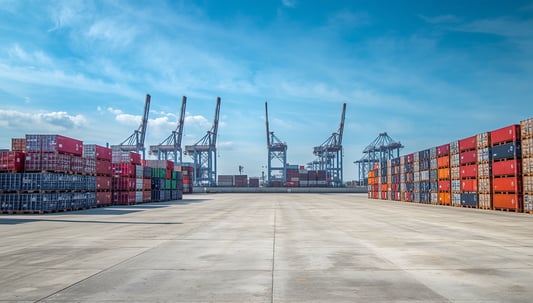

Warehouse Space Near LA & Long Beach Ports
Available Now
Your container just cleared customs at Long Beach. The drayage clock is running, and your warehouse is already full.
260,000+ sq ft of secure, port-adjacent space, minutes from the LA & Long Beach ports, is available now. Short-term, flexible, and ready to onboard fast.
For hundreds of brands importing through the Ports of Los Angeles and Long Beach in 2025, it became an operational reality, sometimes overnight. Tariff front-loading surges compressed months of inbound inventory into weeks. Record cargo volumes stacked up at both ports. And when containers finally released, brands scrambled for somewhere to put the freight.
If you’re managing supply chain for a scaling DTC or B2B consumer brand, you already know: finding short-term, port-adjacent warehouse space in Southern California is genuinely constrained. The region has some of the lowest available warehouse inventory in the country.
This post breaks down why port-adjacent overflow storage has become a strategic necessity, what to look for in a temporary warehouse solution near LA and Long Beach, and how QuickBox’s 260,000+ sq ft of LA-area space is built specifically for this problem. It is available now, on short-term and flexible terms, with quick onboarding and secure, reliable operations.
|
Check Availability → Warehouse Space Availability Request Form |
The Port Problem Is Here to Stay
The Ports of Los Angeles and Long Beach together handled approximately 27% of all U.S. containerized cargo traffic. For brands sourcing from Asia, they’re often the only viable entry point.
And in 2025, that concentration of volume created a cost cascade that caught a lot of brands flat-footed.
The Port of Long Beach processed 8.2 million TEUs through October 2025, up 4.1% year-over-year, its busiest year on record. Tariff front-loading drove record cargo volumes at both LA and Long Beach as shippers accelerated shipments ahead of implementation deadlines.
The mid-2025 tariff pause set off exactly the kind of cargo surge that operations teams managing inbound freight had to absorb for the rest of the year.
The cost math most brands felt directly: delayed container release → detention and demurrage charges accumulate → no available near-port storage → inventory sits, costs compound, and fulfillment timelines slip. Every day without a confirmed storage solution is a day of compounding exposure.
Adding to the pressure: the ongoing risk that East Coast labor disputes would reroute containers to an already-strained West Coast network. Brands with Southern California presence and confirmed near-port storage capacity were positioned to absorb that volume. Brands without it weren’t.
The operational takeaway is straightforward. If your supply chain routes through LA or Long Beach, a port-adjacent overflow strategy is table stakes during disruption cycles.
Why Port-Adjacent Warehousing Is a Different Problem Than Generic Storage
Not all warehouse space solves the port overflow problem. Much of our available space sits in the Inland Empire. This translates to: abundant space, a deep warehousing workforce, and rates that are cheaper per square foot than space right at the docks. And because they sit within the LA / Long Beach port ecosystem - connected to both ports by direct highway - drayage and transport costs stay efficient. Costs are fundamentally a function of distance to port: the further inventory travels from the docks, the more brands pay in drayage. Routing through more distant, out-of-region hubs (e.g., Arizona or Utah) only adds that distance back.
Drayage cost compounds with distance, which is why proximity matters. Every additional mile between the port and a receiving facility adds cost in driver time, fuel, and carrier fees, and that cost multiplies across container volume.
Proximity to the port is the variable that matters most. Staying within the Southern California network - the LA / Long Beach ports and the Inland Empire facilities connected to them by direct highway - keeps that friction low; routing to more distant, out-of-region hubs (e.g., Arizona or Utah) reintroduces it.
Beyond cost, staging within the Southern California network creates operational flexibility that distant, out-of-region facilities can’t replicate:
▪ Speed to operational readiness. Inventory arriving at a port-adjacent facility can move directly into retail prep, QC inspection, kitting, or relabeling, without adding in-transit handling days before goods reach a fulfillment center.
▪ Cross-docking and transloading. These are port-specific workflows. Containers arriving from multiple origins need to be consolidated, sorted, and reloaded for onward distribution. That requires proximity to the port and operational infrastructure purpose-built for the task.
▪ Compliance-grade storage. Goods coming off international containers, particularly in health, nutrition, beauty, and CPG categories, need documented, secure, FDA-registered storage. Commercial self-storage doesn’t meet that bar.
Southern California vs. Distant Hubs: What Brands Actually Trade Off
|
Factor |
QuickBox SoCal Network |
Distant, Out-of-Region Hub |
|
Drayage Cost |
Significantly lower |
Far higher; compounds with every mile |
|
Onboarding Speed |
Fast move-in, space ready now |
Slower; new market, new labor |
|
Service Capability |
Cross-docking, transloading, retail staging, VAS |
Storage-only; far from the ports |
|
Contract Flexibility |
Short-term and flexible terms available |
Often requires longer-term commitments |
|
Compliance (FDA) |
FDA-registered |
Rarely FDA-registered |
Six Scenarios Where Temporary Warehouse Space Near the Port Saves Your Operation
If any of these describe your current situation, a port-adjacent solution will serve you better than a general storage search.
1. Overflow Inventory
Your current warehouse is at capacity. A container just cleared customs. You need staged storage immediately, on flexible terms, without committing to a 12-month lease. This is the most common scenario in a tariff front-loading environment, and the most time-sensitive.
2. Port Congestion & Import Delays
Containers are backed up. You need a trusted receiver near the port who can accept freight on short notice and get your goods operational fast. Having a confirmed near-port partner means you’re not scrambling when a container releases unexpectedly.
3. Retail Staging & Prep
Product needs labeling, repackaging, QC inspection, or compliance prep before it ships to Target, Walmart, Sephora, or another retail partner. Near-port is the right place to execute that work, before goods enter the broader distribution network and before errors become chargebacks.
4. Seasonal Peak Demand
Q4 is coming. You’ve front-loaded inventory to beat tariffs or prepare for the holiday surge. You need scalable flex space, on your terms and timeline, that can ramp up fast and doesn’t lock you into capacity you won’t need in January.
See how QuickBox supported a leading CPG brand this past BFCM.
5. Cross-Docking & Transloading
Containers arriving from multiple origins need to be consolidated, sorted, and reloaded for onward distribution. This requires port proximity, operational expertise, and systems infrastructure that a warehouse with no international inbound experience can’t provide.
6. Transitional Warehouse Needs
You’re between 3PL partners, relocating a distribution center, or bridging a logistics network gap. You need trustworthy interim storage that can also handle fulfillment prep, backed by real operational support.
|
Check Availability → Warehouse Space Availability Request Form |
What 260,000+ Sq Ft Near the Port Actually Means for Your Operation
QuickBox’s Southern California facilities sit close to both the Port of Los Angeles and the Port of Long Beach via direct highway access - port-adjacent capacity right where brands need it. The 260,000+ sq ft available now isn’t a single building; it’s a mix of space across several of our Southern California facilities, largely in the Inland Empire - which keeps rates and drayage competitive while staying well-connected to the ports.
It’s available now on short-term, flexible terms built for temporary needs, with quick onboarding and secure, reliable operations. That capacity is part of a 3M+ sq ft, 11-location national network with permanent, fully operated infrastructure.
Here’s what makes it operationally different from a standard overflow warehouse:
▪This is a full 3PL operation with the depth to match. QuickBox ships 36M+ packages annually. It serves 100+ enterprise customers. Every facility in the network is U.S.-based and leased and operated directly by QuickBox, giving full control over infrastructure, racking, systems, labor, and performance.
▪FDA-registered. For health, nutrition, beauty, and CPG brands, this is a compliance requirement. OTC-compliant facilities are operational in Denver, Atlanta, and New Jersey.
▪ Onboarding at scale is proven. QuickBox stood up a dedicated 350,000 sq ft facility for a $12B housewares brand, from site selection to go-live in 45 days, including WMS and ERP integrations and 75+ staff hired and trained in 2 weeks. Temporary warehouse onboarding moves faster than that. The infrastructure, the systems, and the team are already in place. When a popular wellness brand’s prior 3PL stalled under rapid growth (thousands of backorders heading into peak), QuickBox onboarded the brand in under a month before BFCM, cleared the backlog, and scaled it to 60K orders a month at 99% on-time fulfillment.
▪ Inventory visibility is real-time. QuickBox operates a WMS/OMS with inventory updates every ~2 minutes. You see what QuickBox sees: SKU-level, real-time, no black-box operations. That’s inventory intelligence that prevents stockouts, overselling, and the downstream customer service problems they create.
▪ Full-service capability from day one. Retail staging and prep. Cross-docking. Transloading. Kitting. Relabeling. QC with pictures and timestamps. Custom packaging. Returns. Omnichannel fulfillment. QuickBox ships to 120+ retail partners and operates dedicated B2B teams. Brands using temporary warehouse space today can access the full fulfillment relationship when they’re ready, without re-onboarding to a new partner.
The client roster reflects the operational bar: Nutrafol, Hiya Health, IL Makiage, SpoiledChild, and Cricut are among the 100+ customers QuickBox serves across its network, including a $12B global housewares and appliance brand. That’s the standard our LA-area facilities operate to.
|
Ready to confirm space near the port? |
|
Check Availability → Warehouse Space Availability Request Form |
|
| (720) 990-5642 | sales@quickbox.com |
How Quickly Can You Actually Get Started?
The most common objection from brands evaluating port-adjacent overflow storage: “We don’t have time to onboard a new partner right now.”
That’s the wrong frame. You don’t have time not to solve the storage problem, because detention and demurrage charges don’t pause while you evaluate options.
QuickBox’s temporary warehouse process is built for speed. 260,000+ sq ft is available now, minutes from the LA & Long Beach ports, on short-term and flexible terms. Onboarding is quick, move-in is fast, and the space is secure and reliable. The process is simple:
1. Tell us what you need
2. Our team responds quickly
3. Space confirmed
4. You’re operational
No lengthy RFP process. The Check Availability form captures what the team needs to confirm capacity and terms.
The flexibility is intentional. Brands can start with a short-term overflow need and, when the operational fit is clear, transition naturally to a broader 3PL relationship (DTC fulfillment, B2B retail, omnichannel) without switching partners or re-onboarding systems.
QuickBox’s track record on ramp speed removes the “we’re too complex to onboard quickly” objection. A $12B brand’s 350,000 sq ft facility in 45 days is the ceiling of complexity. Temporary warehouse onboarding is straightforward by comparison.
The Port Doesn’t Pause. Neither Should Your Supply Chain.
When inventory hits the port and you have nowhere to put it, every day without a storage solution is another day of compounding detention charges, delayed fulfillment, and operational exposure.
36M+ shipments annually • 100+ customers • 7 FDA-registered facilities • 100% U.S.-based operations • Space available now
|
Get started: |
|
Check Availability → Warehouse Space Availability Request Form |
|
Talk to Our Team → (720) 990-5642 | sales@quickbox.com |