

Packaging is one of the few brand touchpoints you control after the sale. Once an order ships, the box carries the customer experience on its own.
This guide covers which choices support loyalty and which ones you can skip at low volume. It also shows what the total cost looks like once you count minimums, storage, labor, and shipping.
Packaging and Customer Loyalty: What the Research Shows
How an order arrives shapes what people think of the product inside. Recent consumer surveys support that point.
VistaPrint surveyed 1,000 U.S. adults in June 2026, all of whom notice product packaging at least occasionally. In that group, 89% said packaging quality influences how they view the product. Another 64% had kept a piece of branded packaging.
A separate Adobe Express survey of 703 online consumers, conducted in March 2026, found that 73% said premium packaging improved their view of a brand. In the same survey, 57% said they had bought from a brand because packaging from a previous order left a strong impression.
Keep in mind
These figures are self-reported survey responses, and they do not measure actual sales. They show that buyers connect packaging and customer loyalty when describing their choices. Packaging is one factor among several in a repeat purchase.
Packaging does land at a useful moment, after the sale. Harvard Business Review, citing Fred Reichheld of Bain & Company, reported that a 5% lift in retention raises profits by 25% to 95%. That figure applies to customer retention overall and does not isolate the effect of packaging.
Stock vs Custom Packaging: Four Options
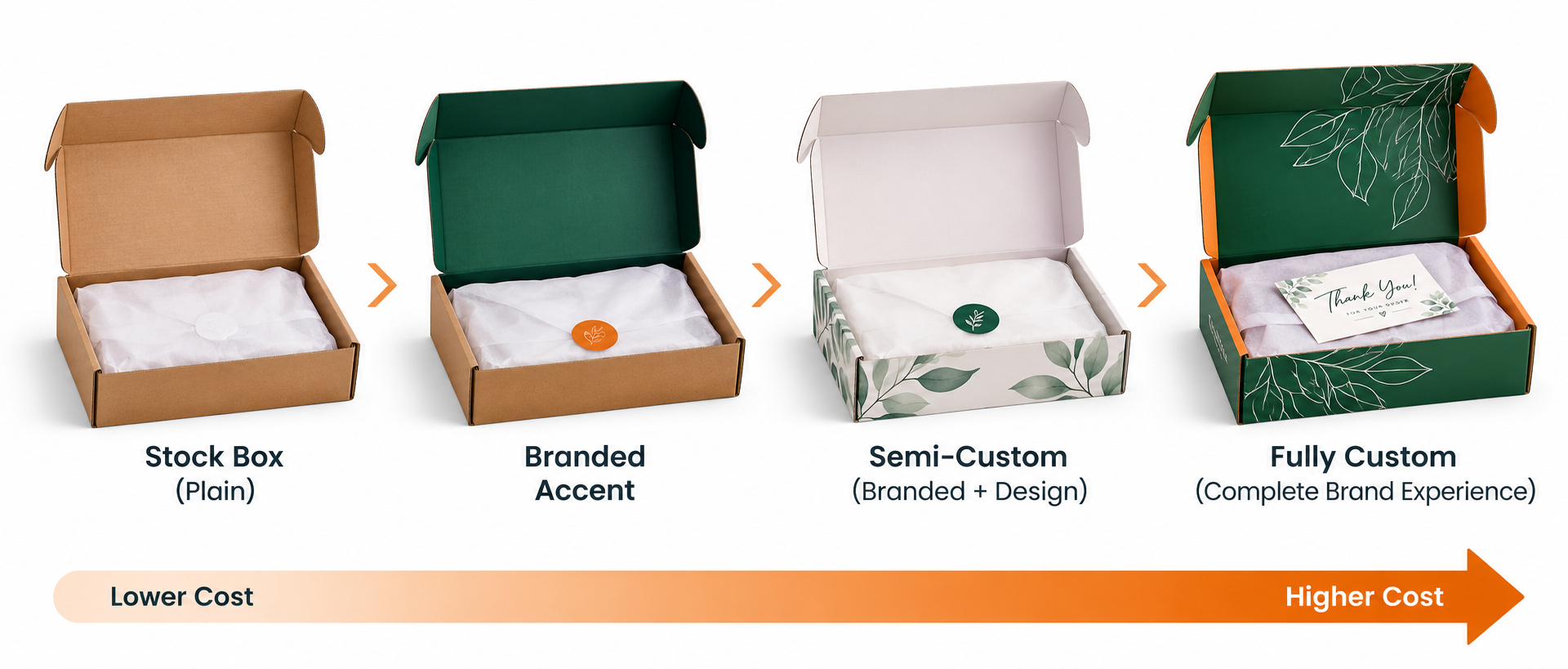
Branded packaging options fall along a range from plain stock boxes to fully custom designs.
- A stock corrugated box or mailer with no branding.
- A stock box with a branded accent, such as a sticker, stamp, or printed tape.
- Semi-custom packaging: a stock size printed with your brand, without a custom die-line.
- Fully custom printed boxes or folding cartons built to your specifications.
Each step up the range changes how the package looks and feels. Volume, product type, and margin should decide where you land.
Affordable Custom Packaging Starts with the Box You Already Use
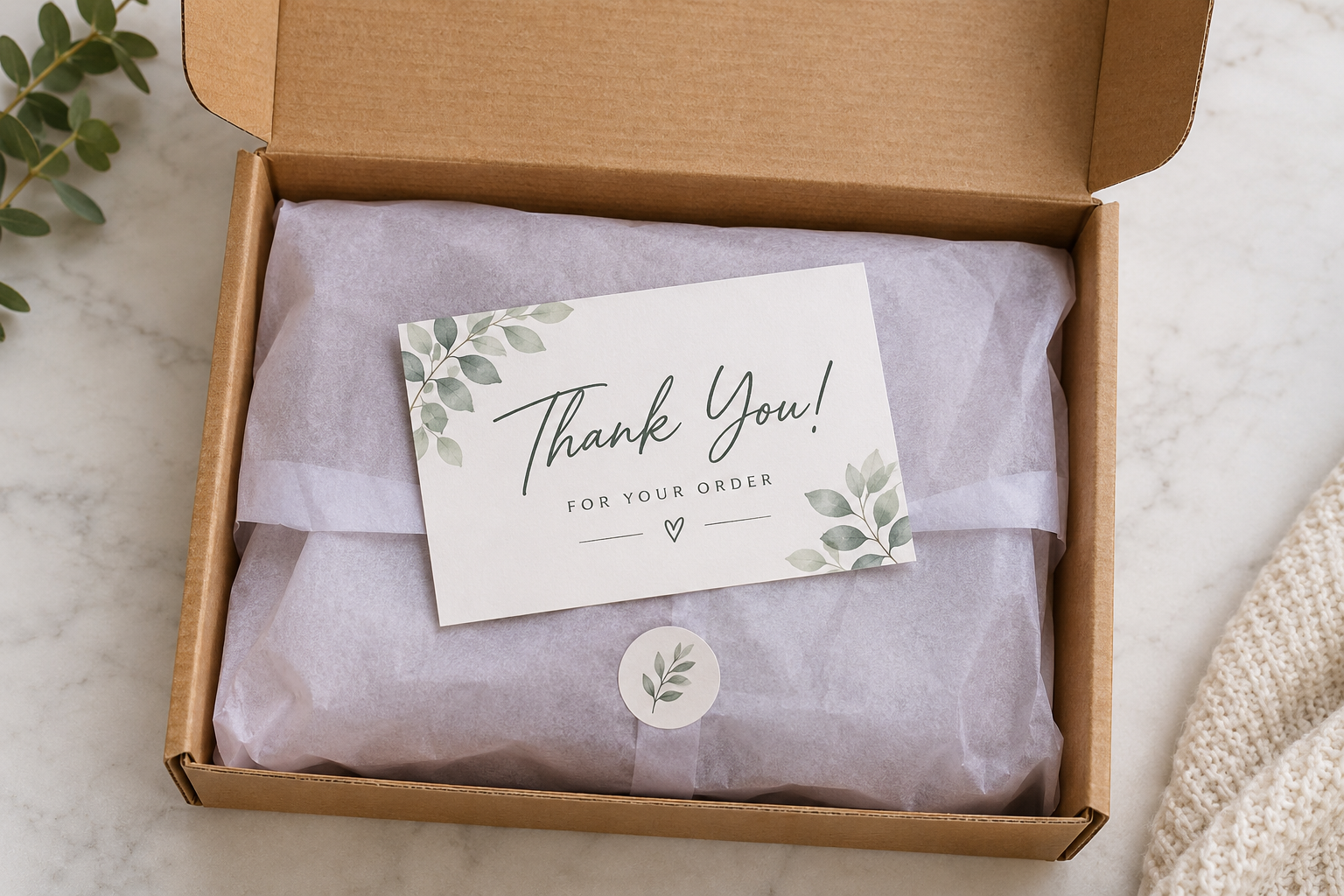
Branded packaging for small businesses often starts on top of a stock box. These touches create a branded unboxing experience without a custom print run.
- Inserts. A thank-you card, care sheet, or discount code adds a personal touch at low cost. In its survey of 300 small business owners, Adobe Express found that 49% rate handwritten thank-you cards their most effective packaging tactic for earning loyalty, yet 62% do not include them.
- Stickers and stamps. A branded seal turns a plain kraft box into a recognizable one.
- Tissue paper. It adds a reveal moment between opening the box and seeing the product.
- Branded tape. It signals the brand before the box is opened.
None of these require a custom minimum, so they work at low order volumes.
When Fully Custom Packaging Pays Off
Volume comes first. A custom run makes sense once you can use the custom packaging minimum order quantity within a reasonable window. Ordering more than you will use moves cost from packaging to warehouse space.
Category matters next. Presentation carries more weight for some products than others. In the VistaPrint survey, 86% of respondents said packaging is important when purchasing a gift. Gifting products, subscription boxes, and premium items are worth evaluating for full customization before replenishment products.
Stability matters too. A custom run becomes a sunk cost if your branding changes, so frequent redesigns and large orders do not mix.
Custom Packaging Costs Beyond the Per-Box Price
The per-box price is only one part of the decision. Four other costs shape the total.
- Minimum order quantities. Suppliers set minimums to cover setup and tooling. Print method affects where the minimum lands, since digital printing and plate-based printing have different setup requirements.
- Storage. Every box above near-term need takes warehouse space, and packaging materials that do not stack well cost more to hold.
- Assembly and labor. Kitting and inserting take longer than closing a stock box, and that cost grows with order volume.
- Dimensional weight. Carriers can bill based on the space a box occupies as well as its weight.
USPS raised dimensional weight charges on large, light parcels in 2026. USPS changed its calculation on July 12, 2026. The divisor dropped from 166 to 139, and every fractional dimension now rounds up to the next whole inch. The rule applies to parcels over one cubic foot, or 1,728 cubic inches.
Cost watch
An oversized box holding a light product now costs more to ship through USPS.
Track cost per order: materials, labor, and any extra shipping cost created by box size.
Right-Sized Packaging and Damage Prevention
A box that is too large lets the product shift in transit. A box that is too small can crush under normal handling. Both lead to replacements and returns.
In a survey by the National Retail Federation and Happy Returns, retailers estimated a 15.8% return rate for 2025, worth $849.9 billion. Online returns run higher, at an estimated 19.3%. The report does not break out returns caused by shipping damage. Any damaged delivery that leads to a return or replacement adds cost.
Right-sized packaging addresses both problems. Watch for warning signs. The product rattles when you shake the box. Void fill fills more space than the product. Customers mention packaging in reviews.
ISTA publishes package testing procedures for parcel shipment, including general simulation tests and temperature tests. You do not need certification to borrow the idea. Test under realistic conditions before placing a large order.
Sustainable Packaging Claims: What You Can Say
Sustainable packaging claims carry legal risk. The FTC Green Guides set out how the agency evaluates environmental marketing claims, including recyclable, compostable, and degradable labels.
The Guides were last revised in 2012. The review the FTC opened in December 2022 has not produced final revisions.
An unqualified recyclable claim generally requires recycling access for a substantial majority of consumers where the item is sold. The Guides define that as at least 60%. Below that level, qualify the claim.
Before printing anything, confirm three things. Most of your customers can recycle the package. The entire package, including any coatings and films, can be recycled, apart from minor incidental components. You can document any recycled materials claim on request.
Legal note
This section is general information and should not be relied on as legal advice. Have counsel review claims before they ship at scale.
Test Before You Scale
A small test run limits the cost of a packaging mistake. Four steps:
- Start small. Low-minimum options let you validate a design first.
- Test it physically. Run a drop test, then check the box in daylight and in product photos.
- Gather customer feedback. A soft launch to a small customer segment shows how real buyers respond.
- Then scale. Use the cost framework above to set the order size.
Keeping Custom Packaging Fulfillment Consistent
A branded unboxing experience only works if every order gets it. Inserts run out. Box styles change mid-run. Both undercut the trust that packaging is meant to build.
Consistency turns packaging strategy into an operations question. It depends on inventory control for packaging materials and documented kitting steps that hold up as volume grows.
Ask any custom packaging fulfillment partner how materials are sourced and counted, how kit components are tracked, and how assembly is documented. QuickBox describes its approach on its custom packaging and kitting services page, with related detail on fulfillment center locations and subscription box fulfillment.
If packaging, kitting, or right-sizing is on your list this quarter, talk to a QuickBox fulfillment expert.
FAQs About Custom Packaging
Does custom packaging increase repeat purchases?
Surveys link the two. In the Adobe Express survey, 57% of consumers said they had bought from a brand because packaging from a previous order left a strong impression. That figure is self-reported, and packaging is one factor among several.
What is the cheapest way to make packaging feel branded?
Inserts, stickers on stock boxes, and colored tissue paper. None require a custom box minimum.
How many boxes do I have to order?
The custom packaging minimum order quantity varies by packaging type and print method. Ask your supplier for current figures, since they change over time.
Does box size affect shipping cost?
Yes. For parcels over one cubic foot, USPS bills the greater of actual weight or dimensional weight, which reflects the space a box occupies. Since July 12, 2026, USPS divides by 139 instead of 166 to calculate it.
Can I call my packaging recyclable?
Only if recycling access reaches a substantial majority of consumers where you sell, which the FTC Green Guides define as at least 60%. Otherwise, qualify the claim. This answer is general information and should not be relied on as legal advice.
